
Geomechanical core testing
The results of geomechanical core analysis are key to accurately understanding of the specific rock properties and constructing accurate geomechanical correlations. The values obtained during testing are calibration points in the geomechanical modeling process, without which the degree of uncertainty in the modelling is significantly higher.
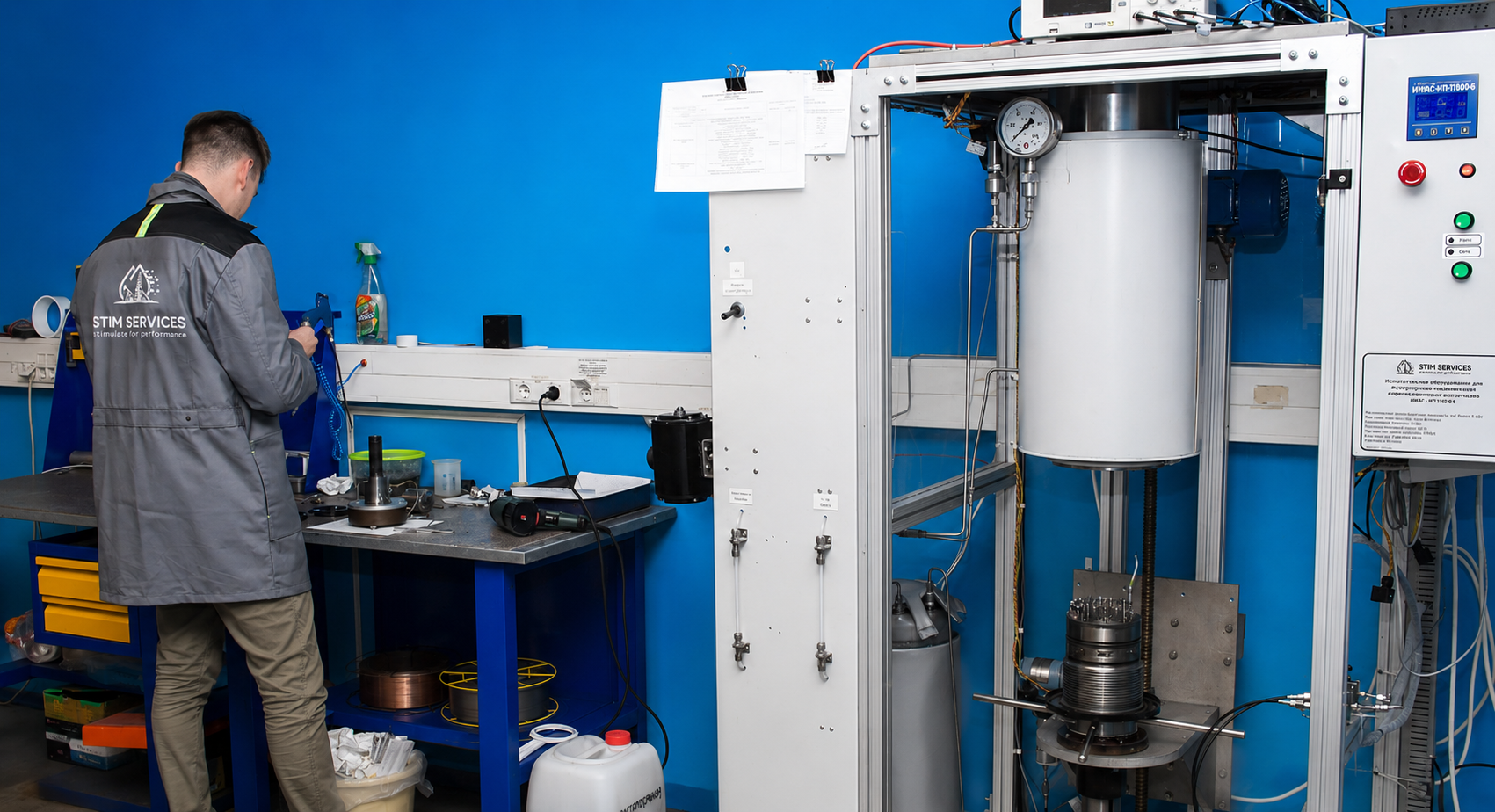
Stim Services performs all the most in-demand tests of the mechanical properties of rocks. The combined measurement data characterizes the ability of rocks to deform under the applied force and determine failure criteria for specimens.
Modern equipment determines elastic moduli both dynamically and statically, also continuously measures pore volume and permeability dynamics under loading.
Rock strength
Rock strength is assessed under both uniaxial (UCS) and triaxial loading conditions. Triaxial compression testing is a reliable method for assessing rock strength by creating effective stresses. Specimens can be loaded with a controlled force rate up to the maximum or with a controlled deformation rate ranging from 1 µm/hour to 50 mm/min, inclusive.
Tensile Strength
The famous "Brazilian Test" is performed to estimate the tensile strength (TSTR). Calibration of this parameter significantly reduces uncertainty in drilling planning by hydraulic fracturing risk minimization, and is important for modeling hydraulic fracturing technology during field development.
ELASTIC PROPERTIES
The triaxial test allows simultaneous acquisition of dynamic and static elastic properties—Young's modulus, Poisson's ratio, Shear modulus, and others. Measurements are performed in several stages—during initial loading, unloading, and reloading under triaxial deformation. Simultaneously, ultrasonic waves are transmitted through the specimen (using 1 MHz transducers) to measure dynamic elastic parameters.
Our laboratory determines:
Strength properties:
Elastic properties:
Pore volume compressibility (PVC) testing allows continuous measurement of pore volume dynamics and petrophysical properties during sample loading. This is particularly relevant for fields in the later stages of development and is also necessary for selecting development methods and maintaining reservoir pressure. Accounting for reservoir depletion is essential to reduce the risk of reservoir loss.
Non-accounting of reservoir pore space and permeability changes in dynamics with decreasing pore pressure can lead to fatal errors in estimating residual recoverable oil reserves. Another common test for assessing wellbore stability and sand production is the thick-wall test (TWT). Fracture toughness (fracture toughness) is assessed to refine hydraulic fracturing design.