
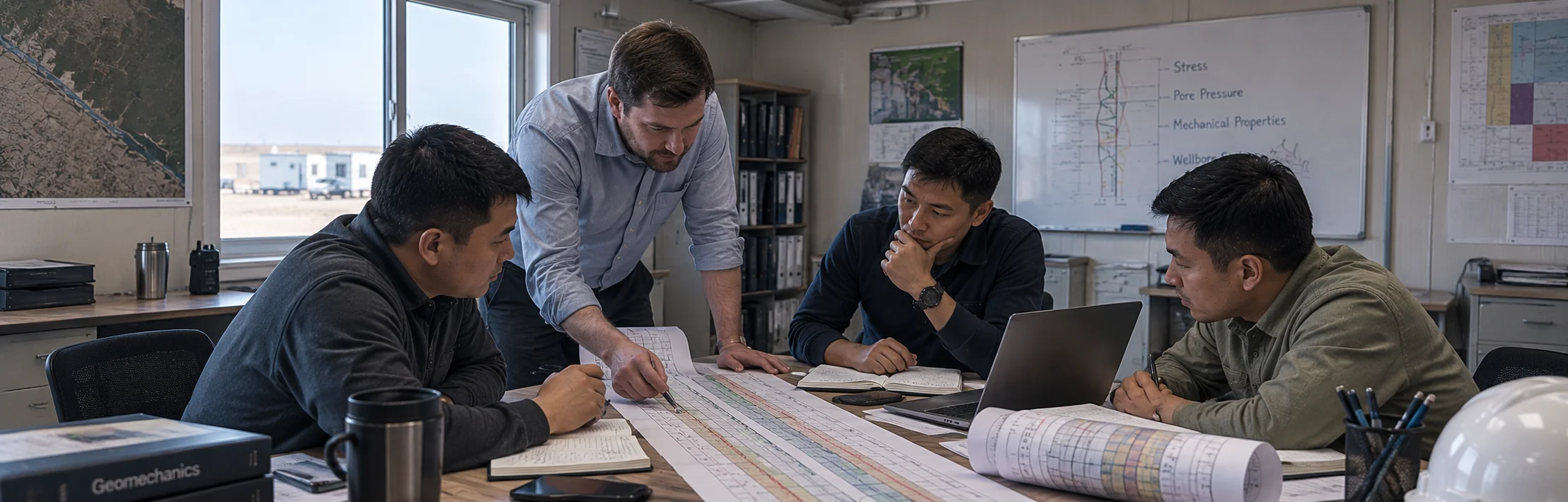
Geomechanical modeling at the design stage is an important tool for efficient construction.
1D MEM (Mechanical earth model)
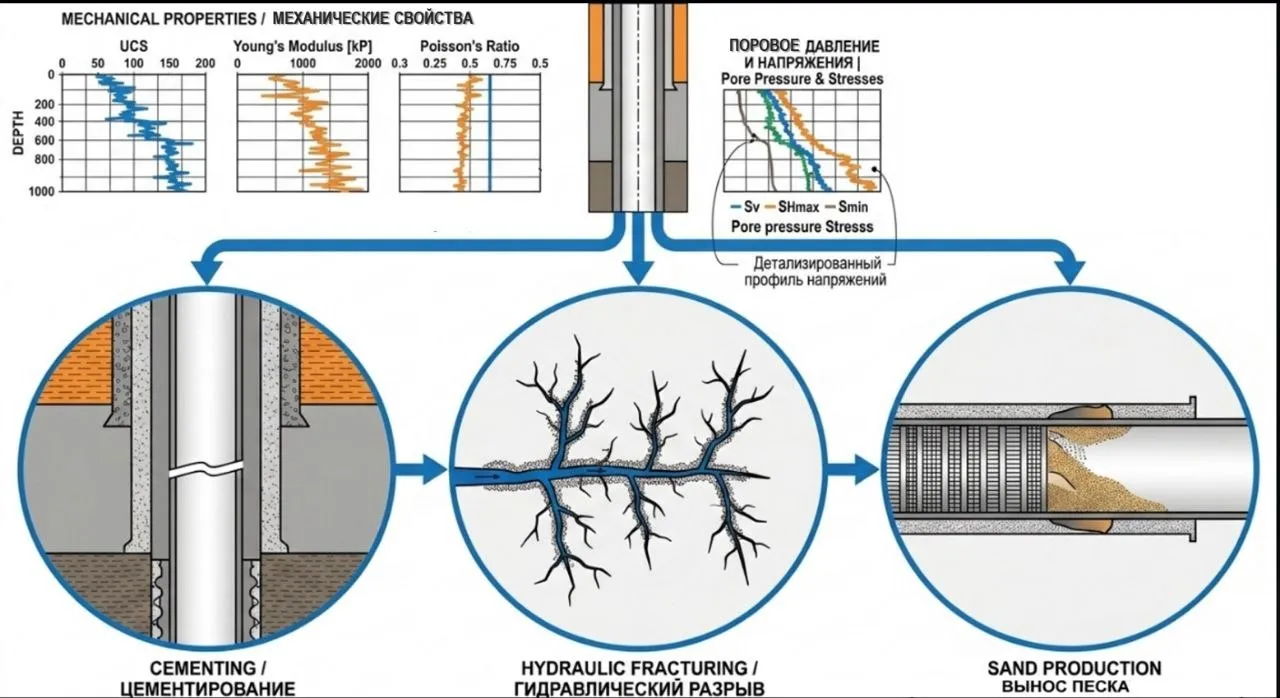
1D MEM (Mechanical Earth model) calculates the stress-strain state of a rock mass along a well trajectory. The results include:
- three principal stresses (vertical σv, minimum σh, and maximum σH horizontal stresses)
- pore and formation pressures
- rock mechanical properties: static and dynamic Young's moduli, Poisson's ratio, uniaxial compressive strength (UCS) and tensile strength, and the angle of internal friction
The model is constructed using well logging data (density and acoustic logging, etc.). The results are calibrated using core data, images, MDT, and well operations (injectivity tests, xLOT, LOT).
MEM results are shared with related engineering groups as the basis for further calculations:
- Cementing engineers receive data to determine maximum pressures during casing operations.
- Fracturing engineers are provided with the wellbore stress profile, fracture initiation pressure, and a full set of formation mechanical properties to build a consistent geomechanical model in the hydraulic fracturing simulator.
- MEM is also used as input parameters for sand analysis.