
3D and 4D geomechanics
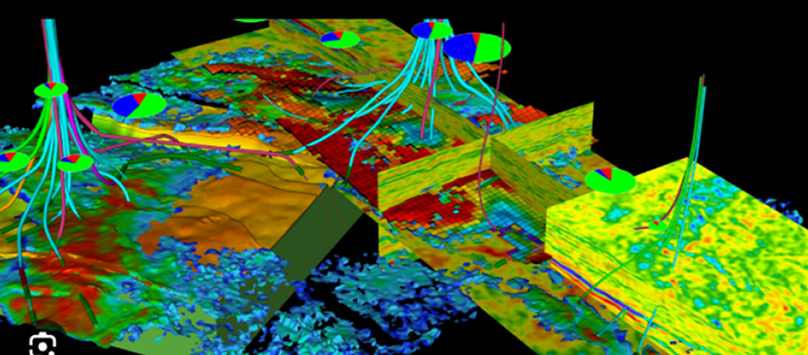
A 3D geomechanical model is a tool that enables rapid calculation of wellbore stability at any point in the field, taking into account the stress tensor, faults, and other geological features such as abnormally high formation pressure (AHFP) and salt bodies.
3D geomechanical modeling is based on the geological model (structural surfaces from scratch, faults) and seismic data. The first step in constructing a 3D model is an audit of offset wells, a high-quality calculation of 1D geomechanical properties and the identification of "verification wells."
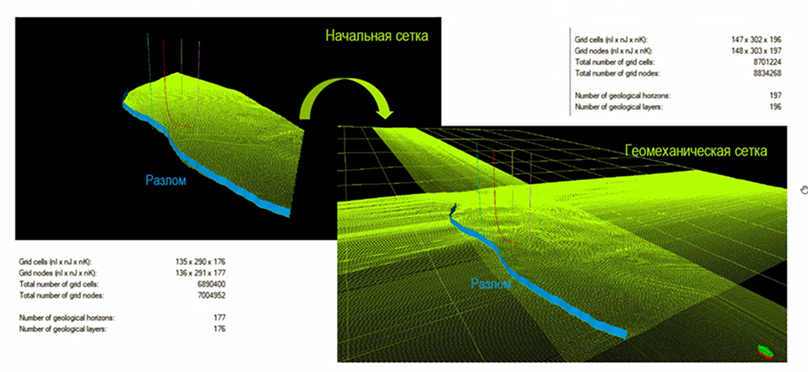
The next critical step is grid generation, where the right balance must be found between model accuracy and the computational time required. Subsequently, mechanical properties will be propagated from the offset wells into 3D according to this grid. Stress calculations includes concideration of existing faults and presence of salt bodies. The deliverables of 3D modeling are cubes of mechanical properties, pore pressure and stresses.
The outcome of 4D geomechanical modeling is a 3D dynamic model that incorporates time and hydrodynamics — fluid movement within the reservoir during production. Coupling the geomechanical and hydrodynamic models allows to predict formation pressure over time and the associated changes in stresses, reservoir properties, and petroelastic characteristics. By integrating hydrodynamics, it becomes possible to rationally define field development and pressure maintenance strategies for long-term cumulative production and the safe drilling of future wells.
A common challenge during field development is formation pressure depletion, which leads to a reduction in stresses and significant changes in the geomechanical model's gradients when drilling new wells. In intervals where no issues were previously observed, mud losses or frequent differential sticking incidents may begin to occur. Another reason for 4D geomechanical modeling is unpredictable fluid saturation, the displacement of hydrocarbons by water or gas, and fluctuations in OWC and GWC levels in wells, which may indicate fault reactivation due to stress reduction in the reservoir. The two-way coupling of hydrodynamics and geomechanics allows for the calculation of potentially active faults and a reassessment of the field development strategy.
In summary, 4D modeling provides an opportunity to look into the future of the field under various production scenarios, integrating geology, tectonics, petrophysical properties, and geomechanics.